
CTET Syllabus 2026 Out - Check Paper 1 & 2 Exam Pattern and Topics at ctet.nic.in
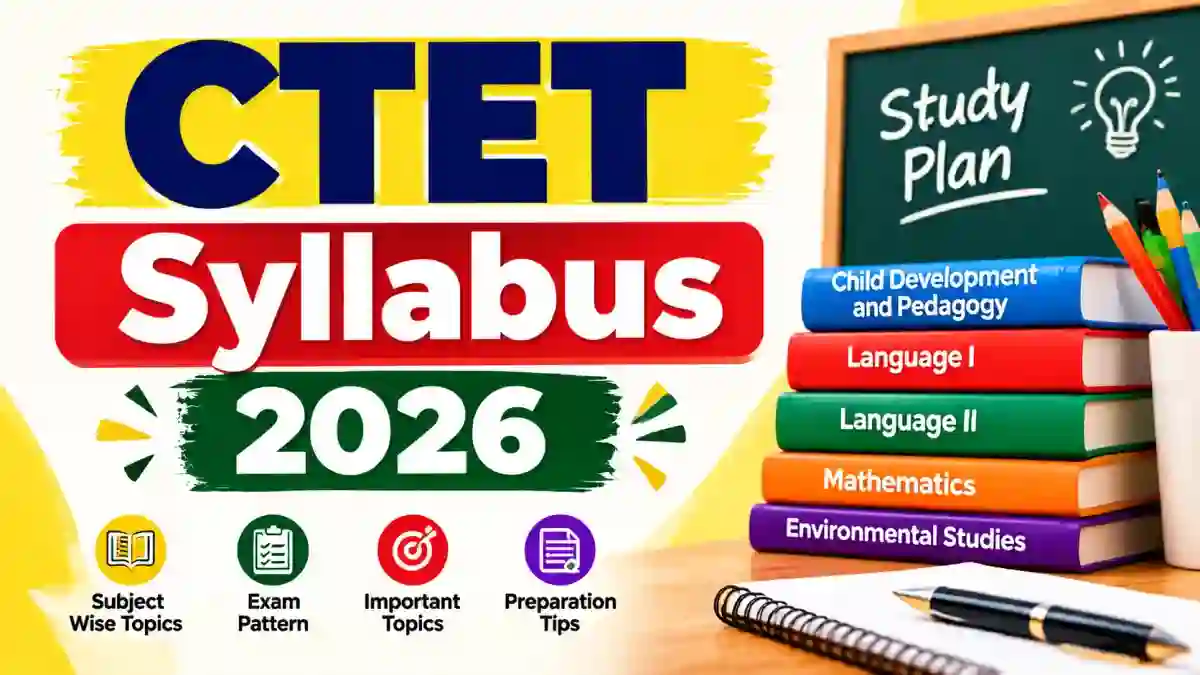
The Central Teacher Eligibility Test (CTET) is conducted by the Central Board of Secondary Education (CBSE) to determine eligibility for teaching positions in central government schools such as KVS, NVS and EMRS. This article covers the complete CTET Syllabus 2026 for Paper 1 and Paper 2, along with the exam pattern, marking scheme, qualifying criteria and subject-wise topics. Understanding the syllabus and exam pattern together helps candidates plan a focused preparation strategy instead of studying topics that carry little weight in the actual paper.
CTET Syllabus and Exam Pattern 2026 - Overview
| Detail | Information |
|---|---|
| Exam Name | Central Teacher Eligibility Test (CTET) 2026 - 22nd Edition |
| Conducting Body | Central Board of Secondary Education (CBSE) |
| Exam Date (Revised) | December 12 and 13, 2026 |
| Exam Mode | Offline, Pen and Paper (OMR based) |
| Number of Papers | 2 (Paper 1 and Paper 2) |
| Total Questions per Paper | 150 (Multiple Choice Questions) |
| Total Marks per Paper | 150 |
| Duration per Paper | 2 Hours 30 Minutes (150 minutes) |
| Negative Marking | None |
| Certificate Validity | Lifetime |
| Official Website | ctet.nic.in |
CTET Exam Structure and Eligibility for Paper 1/ Paper 2
CTET is a single-stage qualifying exam - there is no separate interview or physical test stage. Candidates simply need to score at or above the qualifying marks in the paper(s) they attempt. The choice of paper depends on the teaching level a candidate is aiming for:
| Paper | Who Should Appear | Class Level |
|---|---|---|
| Paper 1 | Candidates who want to teach Classes 1 to 5 | Primary Level |
| Paper 2 | Candidates who want to teach Classes 6 to 8 | Upper Primary Level |
| Both Papers | Candidates who want to be eligible for Classes 1 to 8 | Both Levels |
Candidates who wish to be eligible for both primary and upper-primary teaching posts can appear for both papers, usually on the same day, by paying the fee applicable for each paper.
CTET Exam Pattern 2026
Paper 1 Exam Pattern (Classes 1-5)
| Section | No. of Questions | Marks |
|---|---|---|
| Child Development & Pedagogy (CDP) | 30 | 30 |
| Language I (as per choice) | 30 | 30 |
| Language II (different from Language I) | 30 | 30 |
| Mathematics | 30 | 30 |
| Environmental Studies (EVS) | 30 | 30 |
| Total | 150 | 150 |
Paper 2 Exam Pattern (Classes 6-8)
| Section | No. of Questions | Marks |
|---|---|---|
| Child Development & Pedagogy (CDP) | 30 | 30 |
| Language I (as per choice) | 30 | 30 |
| Language II (different from Language I) | 30 | 30 |
| Mathematics & Science (for candidates who want to be Maths/Science teachers) | 60 | 60 |
| Social Studies / Social Science (for candidates who want to be SST teachers) | 60 | 60 |
| Total | 150 | 150 |
Candidates attempting Paper 2 must choose either the Mathematics & Science section or the Social Studies / Social Science section based on the subject they wish to teach; both are not attempted together.
Marking Scheme and Qualifying Marks
- Every question carries 1 mark.
- There is no negative marking for incorrect or unattempted answers.
- General / Unreserved category candidates need a minimum of 90 out of 150 marks (60%) to qualify.
- SC / ST / OBC / PwD category candidates need approximately 82-83 out of 150 marks (around 55%) to qualify. Different sources report this figure as either 82 or 83; candidates should confirm the exact number against the official CTET Information Bulletin.
- A separate category-wise breakdown for EWS candidates is not specified in the sources reviewed for this article - verify this against the official notification once available.
CTET Syllabus 2026 - Paper 1 Subject-Wise Topics
Paper 1 covers five sections: Child Development & Pedagogy, Language I, Language II, Mathematics and Environmental Studies. Each is detailed below.
1. Child Development and Pedagogy (CDP) - 30 Marks
(A) Child Development (Primary School Child) - 15 Questions
- Concept of development and its relationship with learning; principles of child development
- Role of heredity and environment in shaping the child
- Socialisation processes: social world and children - teachers, parents and peers
- Piaget, Vygotsky and Kohlberg - theories of cognitive and moral development
- Child-centred and progressive education: concept, principles and classroom application
- Concept of multi-dimensional intelligence (Gardner) and critical perspective on intelligence testing
- Gender as a social construct; gender roles, gender bias and educational practice
- Individual differences based on language, caste, gender, community and religion
- Assessment for learning vs. assessment of learning; CCE and school-based assessment
- Formulating questions to enhance critical thinking in the classroom
(B) Inclusive Education and Children with Special Needs - 5 Questions
- Addressing the needs of gifted, creative, specially-abled and disadvantaged learners
- Learning disabilities such as dyslexia, dyscalculia and ADHD - identification and classroom strategies
- Strategies for building an inclusive classroom
(C) Learning and Pedagogy - 10 Questions
- How children think and learn; motivation and learning environment
- The child as a problem solver; alternative conceptions of learning
- Factors affecting learning - attention, perception and memory
- Key guidelines from NCF 2005 and NEP 2020 relevant to primary education
2. Language I - 30 Marks
- Language Comprehension (15 questions): unseen prose/drama passage and a poem, with questions on comprehension, inference, grammar and verbal ability
- Pedagogy of Language Development (15 questions): language acquisition, principles of language teaching, role of listening and speaking, role of grammar, challenges of teaching in a diverse classroom, language skills (LSRW), teaching-learning materials and remedial teaching
3. Language II - 30 Marks
- Comprehension (15 questions): two unseen prose passages (discursive, literary, narrative or scientific), with grammar and verbal-ability questions
- Pedagogy of Language Development (15 questions): language acquisition and learning, approaches and methods of teaching, communicative language teaching, and evaluation of language proficiency
4. Mathematics - 30 Marks
- Content (20 questions): geometry and spatial understanding, numbers, addition and subtraction, multiplication, division, measurement (length, weight, capacity, time, area), data handling, patterns and money
- Pedagogical Issues (10 questions): nature of mathematics and logical thinking, place of mathematics in the curriculum, language of mathematics, community mathematics, evaluation methods, error analysis and remedial teaching
5. Environmental Studies (EVS) - 30 Marks
- Content (20 questions): Family and Friends (relationships, work and play, animals, plants), Food, Shelter, Water, Travel, and Things We Make and Do
- Pedagogical Issues (10 questions): concept and scope of EVS, integrated EVS, environmental education, learning principles, activities and experimentation, and comprehensive and continuous evaluation
CTET Syllabus 2026 - Paper 2 Subject-Wise Topics
Paper 2 covers Child Development & Pedagogy, Language I, Language II, and either Mathematics & Science or Social Studies / Social Science, depending on the subject stream chosen.
1. Child Development and Pedagogy (CDP) - 30 Marks
- Child Development (15 questions): adolescent development, Piaget's formal operational stage, Vygotsky's Zone of Proximal Development, Kohlberg's moral reasoning, individual differences, gender and socialisation
- Inclusive Education (5 questions): gifted and creative children, learning disabilities, strategies for children with special needs, inclusive classroom environment
- Learning and Pedagogy (10 questions): motivation in adolescents, critical thinking development, teaching strategies for abstract concepts, assessment of learning, NEP 2020 and NCF guidelines
2. Language I and Language II - 30 Marks Each
The structure mirrors Paper 1, with questions set at a level appropriate for the upper primary stage (Classes 6-8):
- Comprehension (15 questions): unseen passages with grammar and inference-based questions
- Pedagogy of Language Development (15 questions): language acquisition, teaching methods, diversity in classrooms, LSRW skills and remedial teaching
3(A). Mathematics and Science - 60 Marks (for Maths/Science teacher aspirants)
Mathematics (30 questions: 20 content + 10 pedagogy)
- Number System: knowing numbers, whole numbers, integers, fractions
- Algebra: introduction to algebra, ratio and proportion, simple linear equations
- Geometry: basic geometrical ideas, elementary shapes, symmetry, construction
- Mensuration: area, perimeter, surface area and volume of 2D and 3D figures
- Data Handling: data collection and representation, mean, median, mode
- Pedagogical Issues: nature of mathematics, place of mathematics in the curriculum, problem-solving, error analysis and evaluation methods
Science (30 questions: 24 content + 6 pedagogy)
- Food: sources, components, cleaning food
- Materials: materials of daily use, fibres to fabric, metals and non-metals
- The World of the Living: cell structure, reproduction in plants and animals, microorganisms, body movements
- Moving Things, People and Ideas: force, pressure, friction, sound, electricity, light
- How Things Work: electric circuits and magnets
- Natural Phenomena: earthquakes, reflection and refraction of light, weather and the water cycle
- Natural Resources: air, water, coal and petroleum, conservation and pollution
- Pedagogical Issues: nature and structure of science, integrated approach, observation and experimentation, evaluation and remedial teaching
3(B). Social Studies / Social Science - 60 Marks (for SST teacher aspirants)
History
- Early societies: hunters and gatherers, the Indus Valley Civilisation, Janapadas and Mahajanapadas, the Mauryan Empire
- Religious and cultural developments: Jainism, Buddhism, the Gupta period, the Silk Route
- Medieval India: the Delhi Sultanate, Cholas and Rajputs, the Mughal Empire, Bhakti and Sufi movements
- Colonial period: the East India Company, land revenue systems, tribal uprisings, the Revolt of 1857
- Modern India: 19th-century social reform, the nationalist movement, Partition and the framing of the Constitution
Geography
- The Earth's interior, rocks and major relief features
- Globe: latitudes, longitudes and time zones
- Air and water: composition, weather and climate, the hydrological cycle
- Natural vegetation, wildlife and biodiversity conservation
- Human settlements, agriculture, industries, transport and communication
- Resources and sustainable development
Social and Political Life / Civics
- Democracy and features of the Indian democratic system
- Central, State and Local Government, including Panchayati Raj
- Parliament and the Judiciary
- Social justice, media and gender discrimination
- Marginalisation of Dalits, minorities and tribal communities
- Making of the Constitution and key provisions
Pedagogical Issues for Social Studies (6-8 questions): concept and nature of Social Science/Social Studies, classroom processes and discourse, developing critical thinking, and use of enquiry and empirical evidence.
How to Prepare for CTET Exam 2026
- Start with the official syllabus, not a generic list - map every topic to the section and marks it carries before making a study plan.
- Give Child Development and Pedagogy dedicated time; it is common to both papers and tests concepts, not memorisation.
- For EVS, Science and Social Studies, study directly from NCERT textbooks of the relevant classes and connect concepts to real-life examples.
- Since there is no negative marking, plan to attempt every question in both papers rather than skipping unfamiliar ones.
- Solve previous years' CTET question papers regularly to understand question framing and recurring topics.
- Take timed, full-length mock tests closer to the exam date and revise weak sections based on the results.
CTET Syllabus 2026 - Important Links
Frequently Asked Questions
What is the CTET syllabus 2026?
The CTET 2026 syllabus covers Child Development and Pedagogy, Language I, Language II, and either Mathematics and EVS (Paper 1) or Mathematics/Science and Social Studies (Paper 2), as detailed in the sections above.
What is the exam pattern for CTET 2026?
Each paper has 150 multiple-choice questions worth 150 marks, to be completed in 2 hours 30 minutes, with no negative marking.
How many questions are asked in the CTET exam?
Each paper (Paper 1 or Paper 2) contains 150 questions. A candidate attempting both papers will attempt 300 questions in total across the two papers.
Is there negative marking in the CTET exam?
No. There is no negative marking in CTET. Marks are awarded only for correct answers, and no marks are deducted for wrong or unattempted questions.No. There is no negative marking in CTET. Marks are awarded only for correct answers, and no marks are deducted for wrong or unattempted questions.
What are the CTET 2026 qualifying marks?
General/Unreserved candidates need a minimum of 90 out of 150 marks (60%) to qualify. SC/ST/OBC/PwD candidates need approximately 82–83 out of 150 marks (around 55%); candidates should verify the exact figure against the official CTET Information Bulletin.
When is the CTET 2026 exam?
CTET 2026 was originally scheduled for September 6, 2026, but has been postponed. As per CBSE's notice dated September 14, 2026, the revised exam dates are December 12 and 13, 2026.